
SAP-Plex Factory Connector
seamless SAP to Plex Manufacturing Integration
The SAP-Plex Factory Connector is a standardized, ISA-95-aligned integration module within Mars PLM that bridges SAP ERP (ECC and S/4HANA) with Plex Manufacturing Cloud by Rockwell Automation.
Bidirectional data flows, delivering end-to-end information continuity from production planning to shop-floor execution and back.
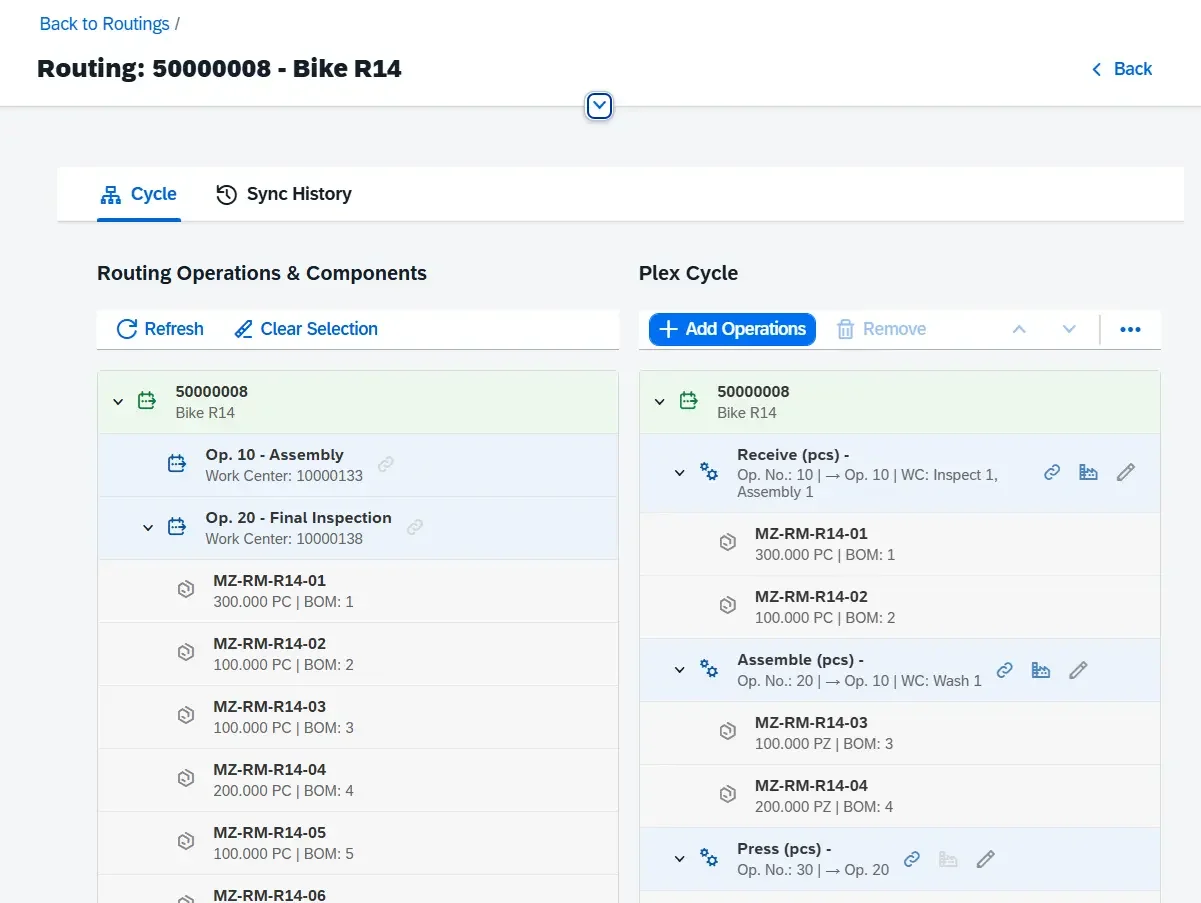
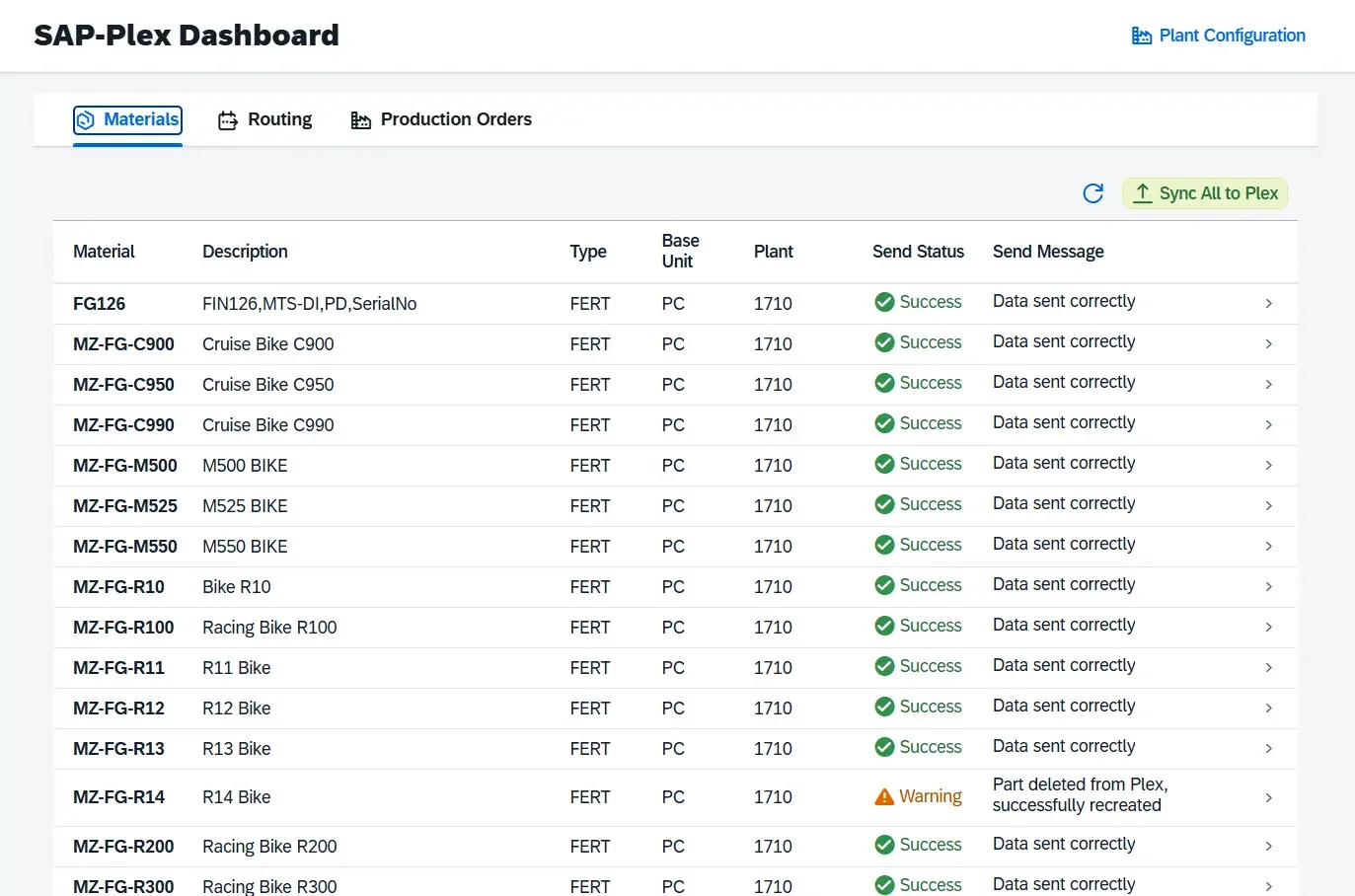
OVERVIEW
Why Do Manufacturers Need SAP-Plex Integration?
Manufacturing enterprises run on two nervous systems: the ERP layer—where demand is planned, materials are managed, and costs are controlled—and the MES layer, where production orders are actually executed on the shop floor. When SAP and Plex Manufacturing Cloud operate in isolation, the gap between planning and execution widens with every shift change, every manual re-entry, and every delayed cost posting.
Industry data shows that disconnected ERP-MES environments typically produce a 2–5% data discrepancy rate, costing organizations hundreds of thousands of euros per year in write-offs alone. Beyond the direct financial impact, operators manually re-key production orders, inventory movements, and quality data between systems—introducing errors and consuming time that could be spent on value-adding work.
The SAP-Plex Factory Connector exists to close this gap. It is not a generic middleware layer; it is a purpose-built integration module that harmonizes the fundamentally different data models of SAP and Plex, ensuring that planning intelligence flows seamlessly into execution and that shop-floor actuals feed back into ERP in real time.
THE CHALLENGE
What Challenges Does Disconnected ERP-MES Create?
Working with a global leader in thermal comfort, we discovered that the real challenge was not simply connecting two APIs—it was aligning the underlying logic of SAP and Plex. Three key learnings emerged from that engagement:
Different Data Models
SAP and Plex structure production data in fundamentally different ways. A classic middleware approach that simply maps fields one-to-one inevitably produces mismatches, orphaned records, and reconciliation headaches.
Heterogeneous SAP Setups
Multi-plant rollouts quickly expose the fact that no two SAP instances are configured identically. What works at one site rarely scales seamlessly to the next without a normalization layer.
ERP Routings ≠ MES Reality
Production routings as defined in SAP's PP module seldom match the operational sequences on the shop floor. Without logic harmonization, discrepancies multiply across shifts and sites.
RISK
The hidden costs of the current state are concrete:
Manual Data Entry
Operators re-key production orders, inventory, and quality data between SAP and Plex — wasting hours per shift.
Delayed Visibility
It takes hours or days before plant-floor actuals reach ERP for planning and finance, undermining decision quality.
High Error Rates
A 2–5% data discrepancy rate translates directly into write-offs, misallocated costs, and unreliable KPIs.
ARCHITECTURE
How Does SAP-Plex Factory Connector Work?
The connector sits as a decoupled, bidirectional integration layer between SAP ERP (ECC or S/4HANA) and Plex Manufacturing Cloud. It runs on SAP BTP (Business Technology Platform) and communicates with Plex via its REST API ecosystem.
ERP Planning & Control
The connector reads from and writes to SAP's PP, MM, QM, SD, and FI/CO modules — covering production planning, materials, quality, sales, and finance.
Mars PLM SAP-Plex Connector
Handles data mapping, API orchestration, error handling with automatic retry, a monitoring dashboard, and multi-plant configuration management.
Shop Floor Execution
Interfaces with Plex's Production Control, Inventory Control, Shop Floor Data, and Shipping/Receiving. Rockwell Edge extends to PLCs, SCADA, sensors.
FEATURES
What Are the Key Features?
Master Data Sync
Items, BOMs, production cycles, and work centers sync automatically. Any SAP master data change propagates to the MES without manual intervention.
Production Order Lifecycle
Orders released from SAP, executed in Plex with full shop-floor data, and confirmed back with actuals — quantities, times, and scrap. Core closed-loop flow.
Cost Feedback
Actual production costs, cycle times, and resource consumption flow from Plex back into SAP’s FI/CO module, feeding variance analysis and budgeting.
Inventory & Materials
Real-time stock movements, consumption, and goods receipts synchronized across both systems, ensuring inventory accuracy across the value chain.
Quality Management
Inspection results, non-conformances, and certificates captured in Plex auto-sync to SAP QM for integrated quality governance.
Multi-Plant Config
Designed for multi-site deployments. Plant-specific configurations, mappings, and business rules managed centrally for rapid rollout.
Monitoring Dashboard
Full visibility into data flows, error states, retry queues, and integration health across all connected plants in real time.
Error Handling & Retry
Automatic retry on network interruptions, API throttling, and temporary unavailability — transient failures never result in data loss.
BENFITS
What Are the Benefits of SAP-Plex Integration?
⚙️ Operational Impact
Orders flow automatically from SAP to Plex—no manual entry in the MES. Production progress is tracked in real time. Scrap is recorded immediately at source rather than at end of shift. Time, machine, and operator reporting is automated. The result is continuous alignment between what was planned and what is actually happening on the floor.
📊 Financial Impact
Automated cost capture and variance analysis replace manual reconciliation. Month-end close accelerates because production cost data is already in SAP. Industrial budgets become more accurate because they are built on real actuals, not estimates. Safety stock requirements drop as inventory accuracy improves.
⛰️ Strategic Impact
The connector is built on ISA-95 principles—the international standard for ERP-MES data exchange—which means clear governance between planning (ERP) and execution (MES). It becomes an enterprise asset rather than tribal knowledge held by a few developers. And it is upgrade-proof: SAP and Plex upgrades are absorbed within a stable architectural framework, not treated as integration-breaking events.
Reduction vs. custom development
From manual entry to value-adding work
Across SAP and Plex systems
Typical return on investment
COMPARISON
Custom Integration vs. Standardized Connector
The table summarizes the key differences between a typical custom SAP-Plex integration and the Mars PLM standardized connector approach,
| Dimension | Custom Integration | Mars PLM Connector |
|---|---|---|
| Timeline | ×6–12 months | ✓6–12 weeks |
| Cost | ×€100K–€300K+ | ✓Fraction of custom |
| Annual Maintenance | ×€50K+ / year | ✓Included in license |
| Upgrade Risk | ×HIGH – breaks on updates | ✓LOW – decoupled layer |
| Scalability | ×Rebuild per plant | ✓Multi-plant ready |
| Key-Person Dependency | ×High – developers’ minds | ✓Low – enterprise asset |
| ISA-95 Alignment | ×Rarely | ✓Native |
INDUSTRIES
Which industries use SAP-Plex Factory Connector?
The connector is designed for discrete manufacturing environments where SAP manages enterprise planning and Plex handles shop-floor execution. Industries that benefit most include:
Tier 1 and Tier 2 suppliers running complex multi-plant operations with stringent traceability and quality requirements.
Manufacturers of HVAC, thermal comfort, industrial pumps, and engineered products with deep BOMs and multi-level routings.
Companies producing appliances, tools, and consumer electronics where volume, quality consistency, and cost control intersect.
Environments demanding end-to-end traceability, rigorous quality documentation, and strict regulatory compliance.
Any organization operating SAP as ERP backbone alongside Plex Manufacturing Cloud for shop-floor execution.

Frequently Asked Questions
-
Yes. The SAP-Plex Factory Connector is designed to integrate with both SAP ECC and SAP S/4HANA. It abstracts the differences between the two ERP generations through its mapping layer, so organizations migrating from ECC to S/4HANA do not need to rebuild their MES integration.
-
A typical deployment takes 6–12 weeks, depending on the complexity of the SAP configuration, the number of plants, and the scope of data flows activated. This compares to 10-20 months for a custom integration approach.
-
The connector uses a decoupled architecture that isolates the integration logic from the internal structures of both SAP and Plex. This means that version upgrades on either side are managed within the existing framework—no re-coding, no integration downtime.
-
Yes. The connector is natively aligned with ISA-95 principles, which define the international standard for ERP-MES data exchange. Planning stays in ERP, execution stays in MES, and the boundary between them is governed by structured, standards-based data flows.
-
Multi-plant deployment is a core design principle. Plant-specific configurations, field mappings, and business rules are managed centrally. Adding a new plant is a configuration exercise, not a development project.
-
Currently available: master data sync (SAP to Plex), production order lifecycle (SAP to Plex to SAP). Releasing soon: cost feedback (Plex to SAP). On the roadmap: inventory and materials (bidirectional) and quality management (Plex to SAP).
-
No. Mars PLM is a native addon that runs within the SAP environment. The SAP-Plex Factory Connector is a module of Mars PLM that bridges SAP to Plex. Both systems retain their full functionality; the connector ensures they communicate seamlessly.
-
The connector includes a real-time monitoring dashboard that tracks synchronization status, error states, and retry queues across all plants. Built-in error handling with automatic retry logic ensures transient failures do not cause data loss.
Ready to close the ERP-MES gap in weeks, not years?
Contact our team to see the SAP-Plex Factory Connector in action.