
Product Change Hub
Engineering Change Management for SAP
Manage engineering change requests and change orders inside SAP ECC and S/4HANA with structured workflows, full traceability, and cross-functional collaboration — from first request to production release.
OVERVIEW
What Is Engineering Change Management in SAP?
A disciplined approach to requesting, evaluating, approving, and implementing product changes — embedded directly in your SAP environment.
Engineering change management (ECM) is the process that governs how modifications to product designs, materials, and specifications move from proposal to execution. In SAP, this revolves around two core objects: the Engineering Change Request (ECR), which captures the need for a change, and the Engineering Change Order (ECO), which authorizes and tracks its implementation.
Standard SAP transactions provide basic ECR and ECO handling, but most manufacturing organizations quickly outgrow them. Complex approval hierarchies, multi-plant rollouts, and regulatory compliance demands require a more capable solution — one that enforces governance without slowing teams down.
Mars PLM Product Change Hub is an SAP engineering change management software module that extends and replaces the standard experience. It delivers configurable workflows, detailed impact analysis, and real-time visibility into every active change — all within a modern, intuitive interface that runs natively on SAP ECC and S/4HANA.
THE CHALLENGE
Why Is Product Change Control Critical for Manufacturing Companies?
Unmanaged changes cascade across engineering, procurement, and production — creating cost overruns, compliance gaps, and delayed launches.
Slow Approval Cycles
Without a centralized change control process, engineering change orders stall in email threads and spreadsheets, delaying time-to-market by weeks or months.
Disconnected Stakeholders
Engineering, quality, procurement, and production often work from different versions of the truth — leading to misaligned BOMs, incorrect parts, and costly rework.
Compliance Blind Spots
Regulatory audits demand a complete revision history. Manual change tracking introduces gaps that put certifications — and customer trust — at risk.
CAPABILITIES
How Does Mars PLM Product Change Hub Streamline Engineering Changes?
A purpose-built module that embeds governance, collaboration, and traceability directly into your SAP change control process.
KEY CONCEPTS
What is the difference between ECR and ECO in SAP?
Understanding the two-stage model at the core of every SAP engineering change management process.
| Engineering Change Request (ECR) | Engineering Change Order (ECO) | |
|---|---|---|
| Purpose | Captures and documents the need for a product change — the "why" and initial proposal. | Authorizes the change and defines exactly how and when it will be implemented. |
| Initiated by | Any stakeholder: engineers, quality, production, customers, suppliers. | Change board or authorized engineering leads, after ECR evaluation. |
| Contains | Problem description, justification, preliminary impact, proposed solution. | Detailed implementation plan, affected objects, effectivity dates, task assignments. |
| Outcome | Approved → ECO is created. Rejected → documented with rationale. | Completed → changes reflected in SAP master data. Revision history updated. |
| In Product Change Hub | Structured forms, automated routing, configurable evaluation criteria. | Task orchestration, real-time tracking, automatic SAP object linking. |
COMPARISON
How Does Product Change Hub Compare to Standard SAP?
Standard SAP transactions handle basic change records. Product Change Hub transforms them into a governed, efficient workflow.
| Capability | SAP Standard | Mars PLM Product Change Hub |
|---|---|---|
| Workflow Configuration | —Fixed, rigid structures | ✓Fully configurable with industry templates |
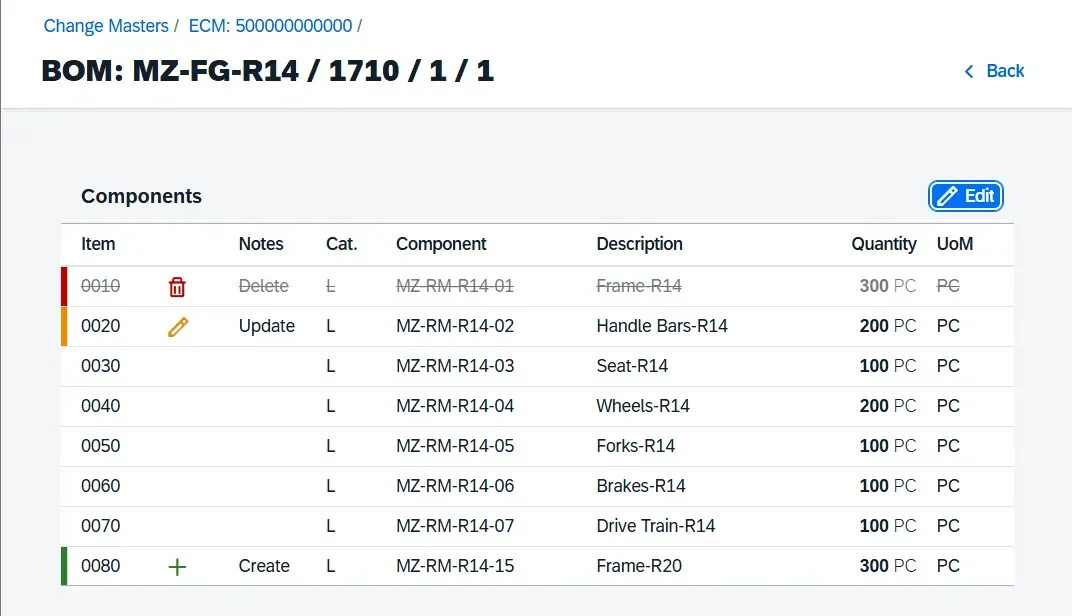
| Impact Analysis | —Manual linking of affected objects | ✓Automatic dependency mapping across BOMs, routings, materials |
| Approval Routing | —Basic sequential approval | ✓Parallel and sequential routing with role-based control |
| Embedded Collaboration | ✕No built-in collaboration | ✓Threaded discussions, traceable feedback within change records |
| Real-Time Dashboard | ✕Limited reporting | ✓Live status, bottleneck, and compliance views |
| Revision Traceability | —Basic change log | ✓Full audit trail with decision context and timestamps |
| User Experience | —Classic SAP GUI | ✓Modern, intuitive UI with personalizable views |
INDUSTRIES
Which Industries Need Advanced Change Management?
Any organization where product modifications carry cost, compliance, or safety implications benefits from structured engineering change control in SAP.
Multi-level BOM changes and revision-heavy products with full traceability across every component.
Regulatory compliance with audit-ready change histories, controlled effectivity, and multi-party approvals.
Formulation and recipe changes coordinated across R&D, quality, regulatory, and production teams.
Fast-cycle seasonal updates and specification changes that keep pace with market demand.
Safety-critical change control for equipment specs and maintenance procedures, fully documented.
Validated change processes aligned with FDA 21 CFR Part 11, EU MDR, and controlled revision histories.
RESULTS
What You Gain with
Product Change Hub
Measurable improvements in speed, accuracy, and compliance across your product change management process.

-
Yes. The module runs natively on both SAP ECC and SAP S/4HANA, with no middleware or third-party connectors required. Your deployment is configured to match your existing SAP landscape.
-
Absolutely. Product Change Hub supports fully configurable process definitions — including custom stages, approval gates, parallel routing, and escalation rules. Industry-specific templates for automotive, aerospace, process manufacturing, and more are available out of the box.
-
When a change request or change order is created, Product Change Hub automatically identifies all linked SAP objects — including BOMs, materials, routings, and documents. Reviewers see a complete dependency map before approving any modification.
-
Standard SAP provides basic ECR/ECO record-keeping through transactions like CC01 and CC02. Product Change Hub extends this with configurable workflows, embedded collaboration, real-time dashboards, automatic impact analysis, and role-based approval routing.
-
Yes. Product Change Hub is part of the broader Mars PLM suite and integrates seamlessly with modules for BOM management, document control, and product data governance.
-
Implementation timelines depend on the complexity of your change processes and the number of SAP plants involved. A typical deployment — including process configuration, user training, and go-live support — is completed within a few weeks.
Frequently Asked Questions about
SAP EngineeringChange Management
Ready to bring structure to your engineering changes?
See how Product Change Hub transforms change control inside SAP — request a guided demo tailored to your industry.